 BuyBest
Home › Best Monitors for PS5 Pro 2026: 4K120, VRR-Checked Picks
Best Monitors for PS5 Pro in 2026: 4K120, VRR-Checked Picks
Start with what the Pro does not change, because most "PS5 Pro monitor" advice gets it wrong. The output ceiling is still 120Hz. The VRR window is still 48-120Hz, with no low-framerate compensation — dips below 48fps judder, and no monitor can fix a console limitation. The HDMI implementation is the base console's, capped at 32Gbps, which is why 4K/120 runs at YUV 4:2:2. What the Pro changes is the image inside that same pipe: PSSR reconstruction to 4K, ray tracing kept on, and frame rates that hold where the base console's sag — Digital Foundry's testing found fidelity-grade settings running at 60-class rates and unlocked modes living in the 80-90fps range inside the VRR window. So this guide is our PS5 guide re-ranked around 4K, with a settings layer, and with the honesty kept: no invented frame rates, every console claim sourced to Sony or a lab.
At a glance
| Monitor | Panel | HDMI for the console | PS5 VRR status | Typical price |
|---|---|---|---|---|
| MSI MPG 272URX | 26.5" 4K QD-OLED, 240Hz | 2x HDMI 2.1 (48Gbps) | Verified on PS5 by a lab | $865-$900 |
| MSI MPG 322URX | 31.5" 4K QD-OLED, 240Hz | 2x HDMI 2.1 (48Gbps) | Supported in our checked data | $960-$1,030 |
| LG OLED evo C5 42 | 42" WOLED TV, 120Hz | 4x HDMI 2.1, all full | Supported | $850-$1,050 |
| Samsung Odyssey G7 G70D | 32" 4K IPS, 144Hz | 2x HDMI 2.1 (bandwidth unpublished) | Per secondary reporting — flagged | $600-$800 |
| Dell S2725QS | 27" 4K IPS, 120Hz | 2x HDMI 2.1 (FRL) | FreeSync Premium 48-120Hz | $230-$300 |
Prices checked November 2026 — live prices at the retailer may differ.
MSI MPG 272URX — the headline Pro pick
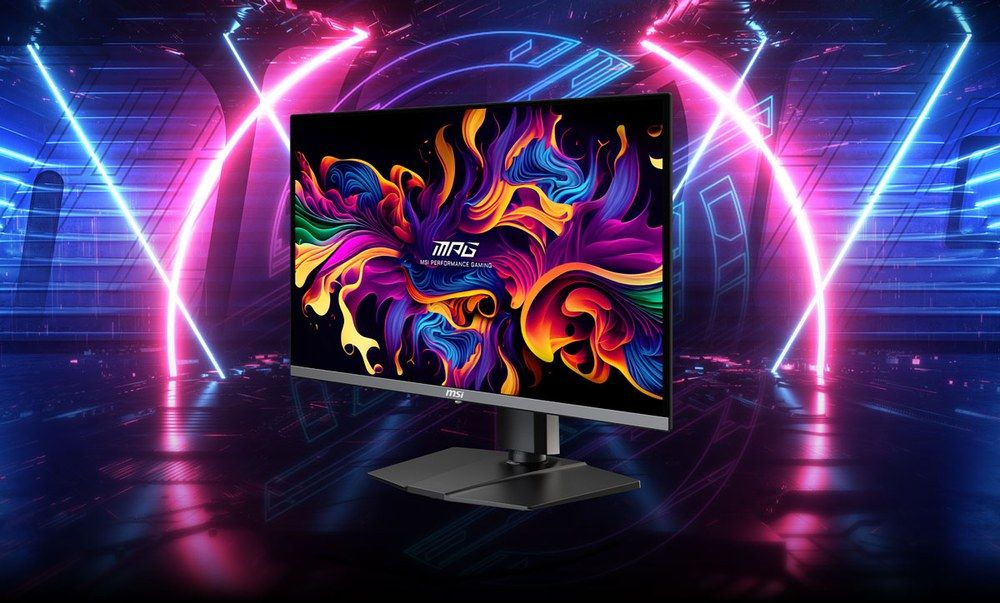
The sharpest panel in this guide — 26.5 inches of 4K is about 166 pixels per inch — which is exactly where a PSSR-reconstructed 4K image has the most to show at desk distance. Its full data lives in our 27-inch guide; the console story is what earns it this slot. MSI fits two HDMI 2.1 ports at 48Gbps, and MonitorGarage's lab review verified the combination that matters on a PlayStation: 4K at 120Hz, HDR, VRR and ALLM, tested on a PS5. That test was on the base console; the Pro's HDMI and VRR implementation is unchanged (HDTVTest's measurement; Sony's shared support documentation), so the compatibility carries — we print the verification as MonitorGarage's and the carry-over as reasoning, not as a second test. HDR is by mode, never a bare number: Peak 1000 mode measured about 1,006-1,026 nits at a 2% window across two labs, True Black 400 in the other. The warranty is the strongest burn-in position here — three years, explicitly including panel burn-in in MSI's own wording — which is the honest answer to the OLED-for-console question, since console HUDs are static. The costs: SDR brightness of roughly 240-270 nits across five labs makes it a dim-room screen, there are no speakers, VRR flicker can appear when frame rates swing hard (an OLED-VRR class trait), and the 240Hz is PC headroom the console will never touch.
Buy if the Pro is your main machine and you want the sharpest verified 4K desk setup.
Skip if your room is bright, or you need speakers in the screen.
- Lab-verified PS5 feature set — the only pick here with it
- 3-year warranty explicitly covering burn-in
- Dim-room screen (SDR ~240-270 nits measured)
- 240Hz is headroom the console cannot use
MSI MPG 322URX — the 32-inch flagship
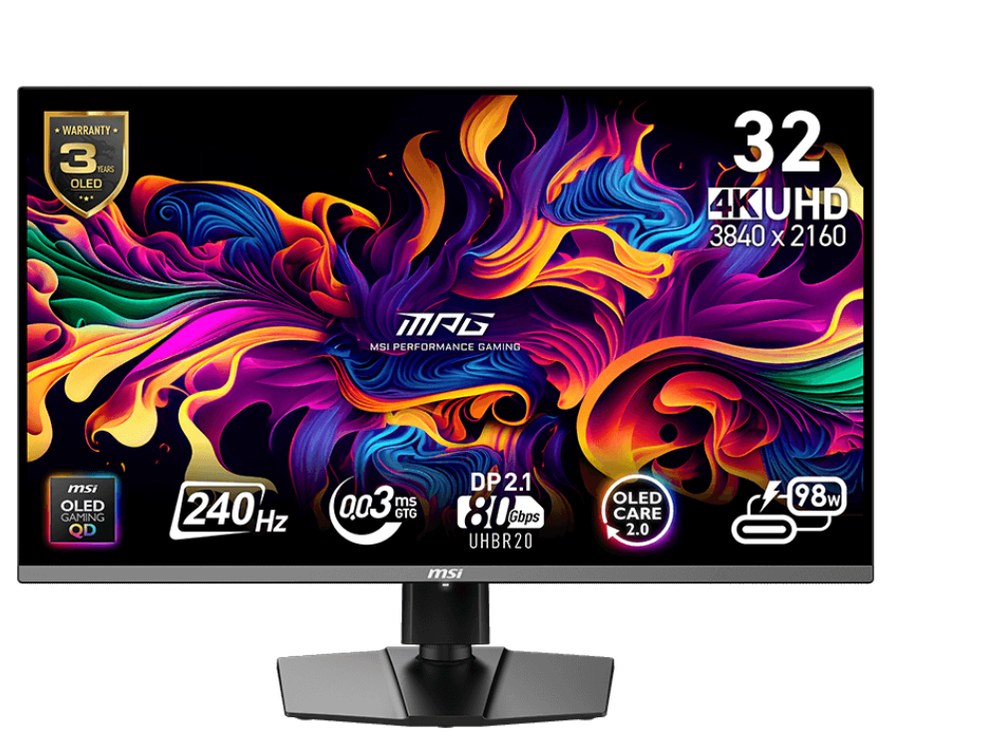
The same console story at 32 inches: two full HDMI 2.1 ports, FreeSync Premium Pro, True Black 400 HDR, and a three-year warranty including burn-in — our full claimed-vs-measured review is here. The choice between this and the 272URX is size against pixel density (about 138 vs 166 ppi), not features: the Pro treats them identically. The base guide's line survives the Pro unchanged — it is far more monitor than the console can max out, so buy it as a flagship for everything on the desk, not for the console alone. Two measured cautions travel with it: TFTCentral noted moderate VRR flicker in dark greys, which matters more on a Pro because VRR is a headline Pro feature, and SDR labs measured below the 250-nit claim (223 and 192 nits) — a dim-room screen, like its sibling.
Buy if you want one flagship screen for the Pro and a PC.
Skip if the console is the only machine — the 272URX shows it more per dollar.
- Full HDMI 2.1 x2, burn-in in the warranty
- The deepest-checked monitor on this site
- VRR flicker in dark greys (TFTCentral)
- SDR measured below claim — dim-room screen
LG OLED evo C5 42 — the living-room Pro
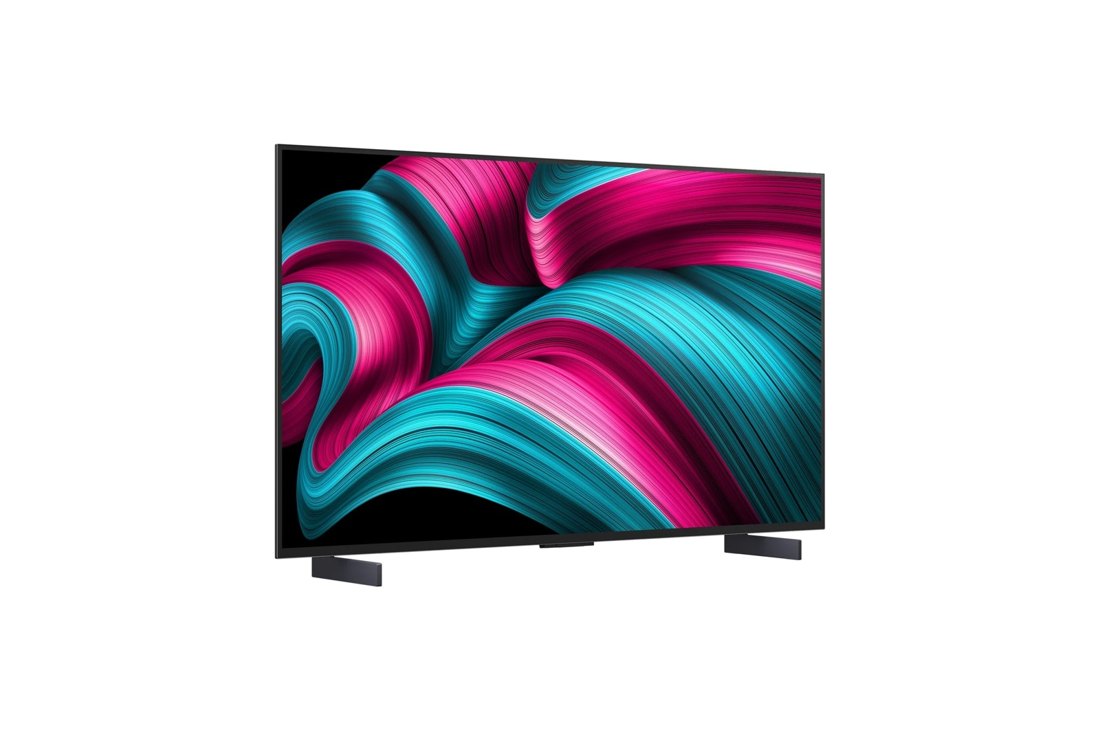
A TV, deliberately: all four HDMI 2.1 ports run 4K/120 with VRR and ALLM, so the Pro's full feature set works on every input, and ALLM matters most exactly here, where picture modes need to switch themselves. You also get real speakers, a remote and the streaming apps — the complete across-the-room package at clearance pricing, because the C5 is a 2025 model replaced by the C6 in 2026. Keep the movie features separate in your head: the Pro outputs HDR10 in games; Dolby Vision is for films. The flags: at 42 inches this is the dimmest C5 (it lacks the Brightness Booster of the larger sizes, per RTINGS via our checked data), there is no DisplayPort, and WRGB text fringing makes it a console and movie screen rather than an all-day desk monitor.
Buy if the Pro lives across the room, not on a desk.
Skip if it must double as your work monitor.
- Every port does the console's full feature set
- Clearance pricing while stock lasts
- Dimmest C5 size; no DisplayPort
- Text fringing rules out all-day desk work
Samsung Odyssey G7 G70D — the LCD 4K route, flags printed
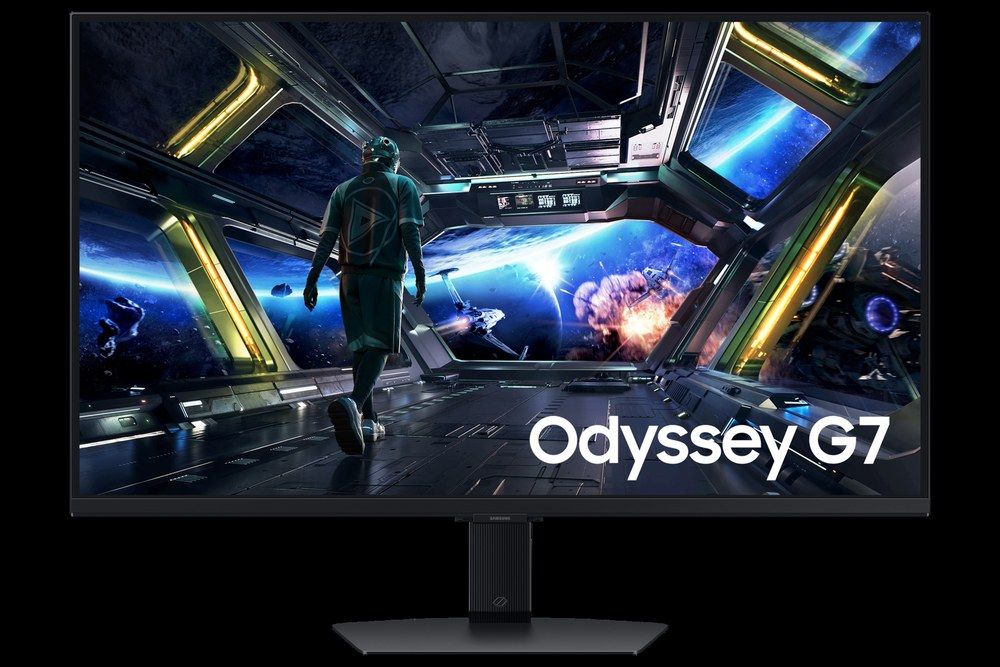
The only current, buyable 32-inch 4K IPS gaming monitor — the class's previous names (LG 32GR93U-B, Gigabyte M32U, Dell G3223Q, ASUS XG32UQ) are all discontinued in the US — so this is the no-burn-in, bright-room route to 4K/120, with measured brightness of 395 nits beating its claim. Its three open questions are printed, not buried. One: Samsung publishes no HDMI bandwidth figure, so we write "HDMI 2.1, bandwidth not published"; console 4K/120 operation rests on secondary reporting of RTINGS' review, and since the console never sends more than 32Gbps, a genuine FRL port maxes it — but we flag the sourcing honestly. Two: Samsung and retailer copy state its FreeSync tier three different ways (plain, Premium, Premium Pro); for the console the operative feature is HDMI Forum VRR, which is flag one. Three: US retailer listings disagree on the warranty (one year vs three) — check Samsung's own warranty lookup for the exact model code before you buy. Add that HDR is its weak side (DisplayHDR 400, contrast measured 841:1 against a 1,000:1 claim) and there is no USB-C or KVM: the case for it is brightness, size, price and never thinking about burn-in.
Buy if you want 4K/120 without OLED's caveats, in a bright room.
Skip if HDR impact is the point of the upgrade.
- The only buyable 32" 4K IPS gaming monitor left
- Measured brighter than claimed (395 nits)
- HDMI bandwidth unpublished; console support second-hand
- Warranty term disagrees across US listings
Dell S2725QS — the budget 4K answer, with its trade printed
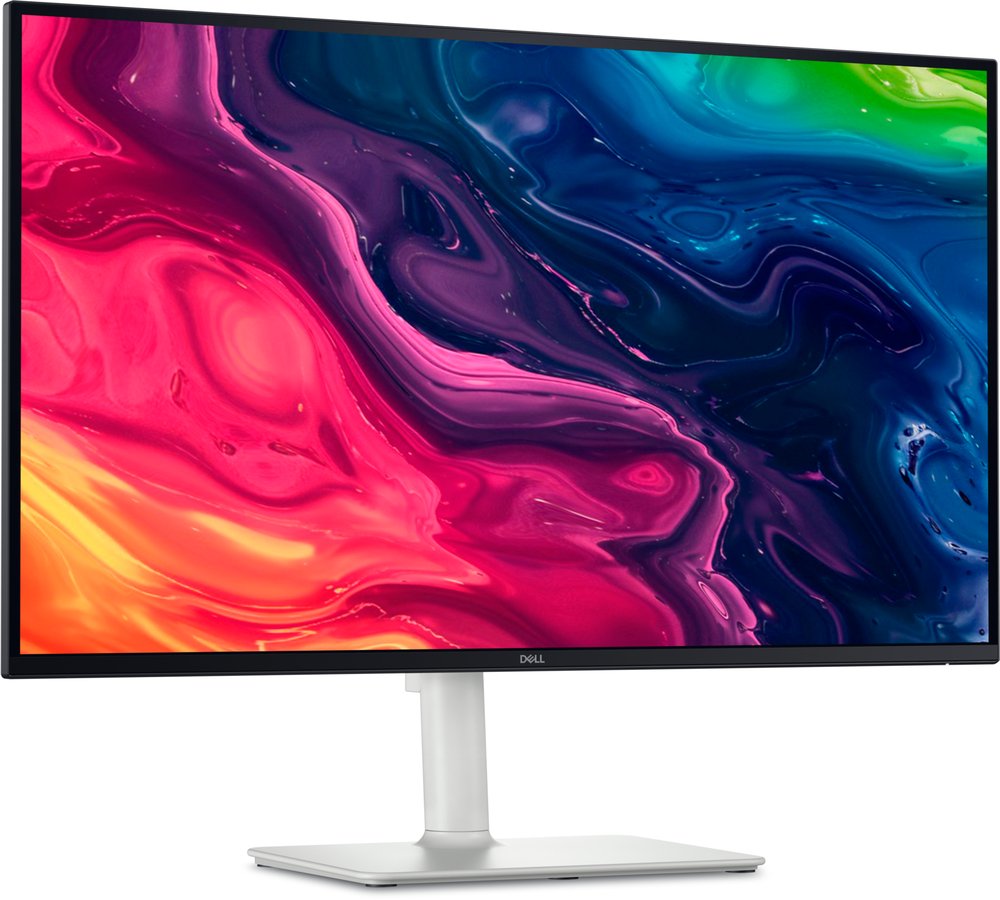
On paper, the cheapest correct answer to what a Pro needs: native 4K, 120Hz on every input (its ceiling is the console's ceiling — nothing wasted), two HDMI 2.1 ports that Dell itself specifies as FRL, a FreeSync Premium window of 48-120Hz that matches the console's exactly, and two 5W speakers. It is a mention rather than a headline pick because of what RTINGS measured in the panel behind that perfect spec sheet: response time rated poor, with visible blur in fast motion, and HDR rated poor — no local dimming, about 75% DCI-P3 in a single lab's measurement — so the right signal arrives at a panel that cannot fully show it. For a Pro owner whose games are slower and whose budget is real, that trade can be the right one. It should just be made with eyes open.
Buy if the budget is firm and your games are not motion-critical.
Skip if fast HDR gaming is why you bought a Pro.
- Cheapest native-4K, 120Hz, FRL route to the Pro
- Speakers built in; nothing in the spec is wasted
- Response time rated poor (RTINGS)
- HDR is a checkbox here, not an experience
Discontinued note — Dell G2724D (the former 1440p value route): it is effectively discontinued in the US — Dell's own store lists it out of stock at $149.99 (checked November 18, 2026) and the price trackers we checked show no US retailer with new stock. If you do find new stock near $150-$200 from a reputable seller, the Pro story at 1440p is sound: its single HDMI port is labelled 2.1 but uses TMDS signalling, which Dell's manual caps at 1440p/144Hz — above the console's ceiling; RTINGS verified PS5 VRR working on this model; and HDTVTest found the Pro's HDMI output unchanged from the base console. No lab has run a Pro-specific test on it, so that carry-over is a labelled inference, not a measurement. Never pay third-party markups, which have run to about $395. No stocked 1440p monitor in our checked data has lab-verified PS5 VRR, so this guide currently carries no 1440p pick. Our G2724D review stays live for owners and stock-hunters.
Assessed, and why they are not picks
Samsung Odyssey Neo G7 32-inch — the base PS5 guide's LCD-HDR pick — is not carried here on stock: every US seller we track is out of stock, B&H lists it discontinued, and we could verify no new US unit at its last street range. On specs it would still serve a Pro well; if you find one new near $600-$750 with easy returns, its HDR remains the LCD benchmark in our guides. LG's 27GS75Q-B is demoted from the base guide's picks: our research resolves its HDMI as 2.0, and while 1440p/120 fits that port, no source verifies PS5 VRR on it — and VRR is half of what a Pro guide exists to promise. MSI's MAG 274UPF E2 ($399.99) is the on-paper sweet spot — 27-inch 4K, 160Hz, an MSI-specified full-bandwidth HDMI 2.1 with console VRR and ALLM — that fails our two-source rule this pass: the labs reviewed the original 274UPF, a materially different variant, not the E2. It is the first re-check at this guide's next refresh.
The honest questions
Is 240Hz wasted on a PS5 Pro? For the console alone, yes, completely — the output tops out at 120Hz, and even the unlocked VRR modes Digital Foundry measured live under that ceiling. Buy the 240Hz OLEDs above because they are the best 4K panels that exist; the refresh is PC headroom. Is 8K a reason to buy anything? No: it is Pro-only, needs an 8K/60 display with DSC, disables VRR while active, and its one showcase reconstructs 4K to 8K in a single first-party racing game. No pick here is an 8K display, and effectively no monitor is. What does 1440p actually lose? The final pixel count of the image PSSR exists to build — a 27-inch 1440p panel shows a (very good) downsample of it, a 27-inch 4K panel shows it. One nuance, labelled as our judgement from the sourced pieces: the Pro is the machine that makes a 1440p panel look its best, since the downsample is now PSSR-grade and the frame rates steadier — and Digital Foundry's GT7 caveat cuts the other way, with the base console's native 4K looking more stable in still scenes than the Pro's reconstruction in that title. "Pro plus 4K" is better on average, not by definition in every game.
Set the console up properly
From Sony's own support documentation: Resolution on Automatic (on a 1440p panel, run Test 1440p Output once, then leave it set). 120Hz Output: Automatic. VRR: Automatic, with Apply VRR to Unsupported Games on. ALLM: Automatic — note Sony's quirk that VRR engages the low-latency mode anyway. Then open Information for Connected HDMI Device and confirm the console itself reports VRR and 120Hz as supported: that screen is your proof the handshake with the monitor worked. Use the cable in the Pro's box or a certified Ultra High Speed cable — and remember the console has no DisplayPort; everything runs over that one HDMI cable. The full port story is in our HDMI 2.1 explainer.
Update history
November 18, 2026: Dell G2724D demoted from pick to a discontinued note: Dell's US store lists it out of stock at $149.99 (checked November 18, 2026) and no tracked US retailer has new stock. This guide now carries no 1440p pick, because no stocked 1440p monitor in our data has lab-verified PS5 VRR.
November 11, 2026: Published: the Pro re-ranked around 4K — 272URX headline with lab-verified console support, the 32Gbps output cap printed, G70D's three open questions flagged, and Neo G7 / 27GS75Q-B / MAG 274UPF E2 assessed honestly.
Sources checked
Specs and prices in this guide were checked against these sources in November 2026 — the manufacturer's own listing plus an independent lab or reviewer, per our two-source rule.
- Sony — PS5 Pro announcement (PlayStation.Blog)
- Sony — PS5 4K resolution guide (PlayStation support)
- MonitorGarage — MSI MPG 272URX lab review (PS5 4K/120Hz, HDR, VRR, ALLM verified)
- MSI MPG 272URX — official specification
- Dell S2725QS — official product page
- RTINGS — Dell S2725QS review
- PCWorld — Dell G2724D review
- FlatpanelsHD — PS5 display setup guide

Akbar Khan Editor, BuyBestMonitor
Akbar has run BuyBestMonitor since its original 2020 launch. Every guide here is checked under the site's two-source rule — manufacturer specs confirmed against an independent lab review — before publication and at every refresh. About the editor · How we check monitors